
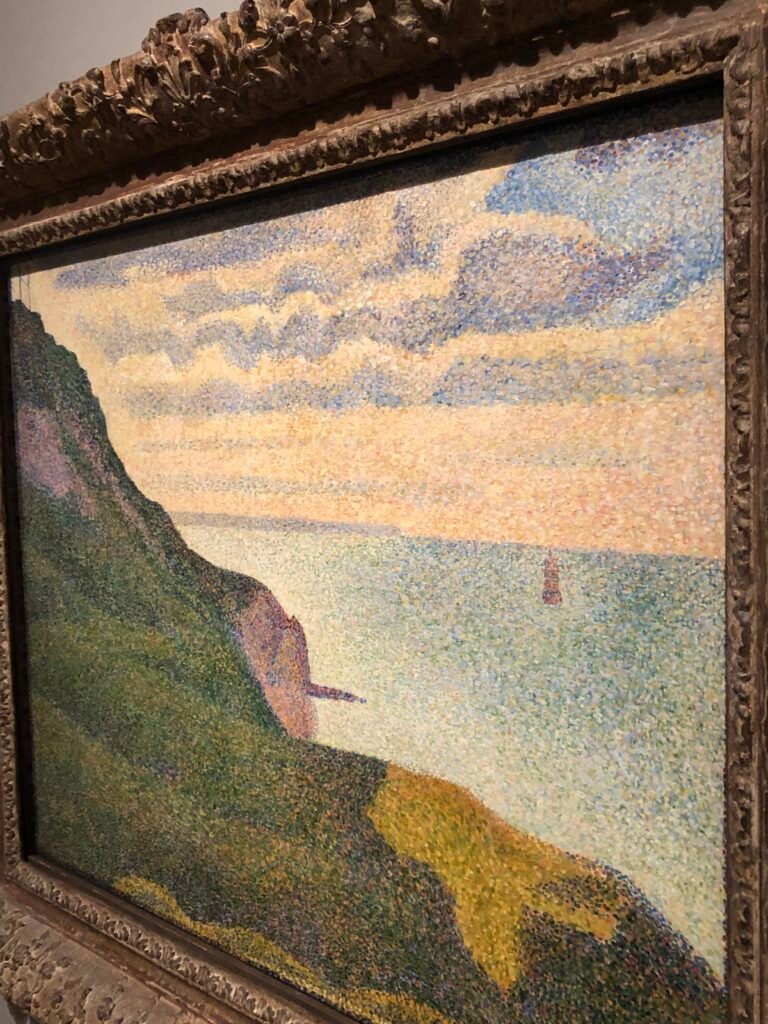
Georges Seurat is chiefly renowned for two huge canvases: A Sunday on La Grande Jatte which hangs in the Chicago Institute of Art and Bathers at Asnieres, which is in the National Gallery in London. Both are extraordinary examples of his style of painting: pointillism, a method in which thousands of tiny dots effectively become blended in the eye of the beholder, frequently making for vivid examples in the use of colour. There was nothing of the size of those two masterpieces at a small exhibition called Seurat and the Sea which is about to conclude at London’s Courtauld Gallery, but there were several fine examples of the art of pointillism, including The Shore at Bas-Butin, taking in the view from around Honfleur in Normandy across to the estuary of the Seine, which is shown on the home page.
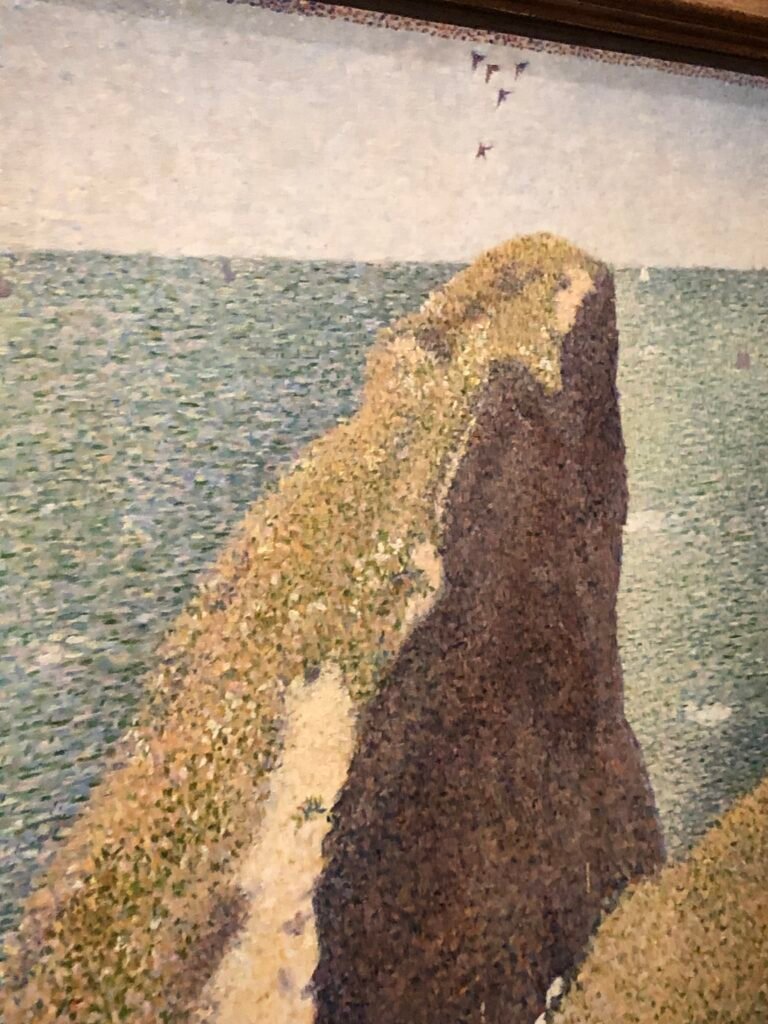
The image depicted above has a historical dimension, too – the ‘Bec’ near Grandcamp no longer exists as it did when Seurat painted it in 1885, a consequence of coastal erosion and the damage the area suffered during the Normandy landings in the Second World War. One particularly striking difference between Seurat’s two large works and most of those on display at the Courtauld is the absence of human figures at the latter. The majority of these evoke the magnificence of the coastline of this part of northern France, in its beauty and at times in its bleakness.
The La Grande Jatte painting was the inspiration behind the creation of the Stephen Sondheim musical, Sunday in the Park with George. That production will be revived at the Barbican next year, with Ariana Grande (who else given the title of the painting?) playing the artist’s mistress. Her name? Dot, of course. An early fan of Seurat’s, Felix Feneon, preferred the term ‘neo-impressionism’ to ‘pointillism’, which ineluctably, of course, leads me on to the topic of impressionist artists. For while the Seurat show at the Courtauld ends on May 17, the gallery has several items of interest and allure in its regular exhibition, not least one specific work by the great impressionist, Edouard Manet, which is shown below.
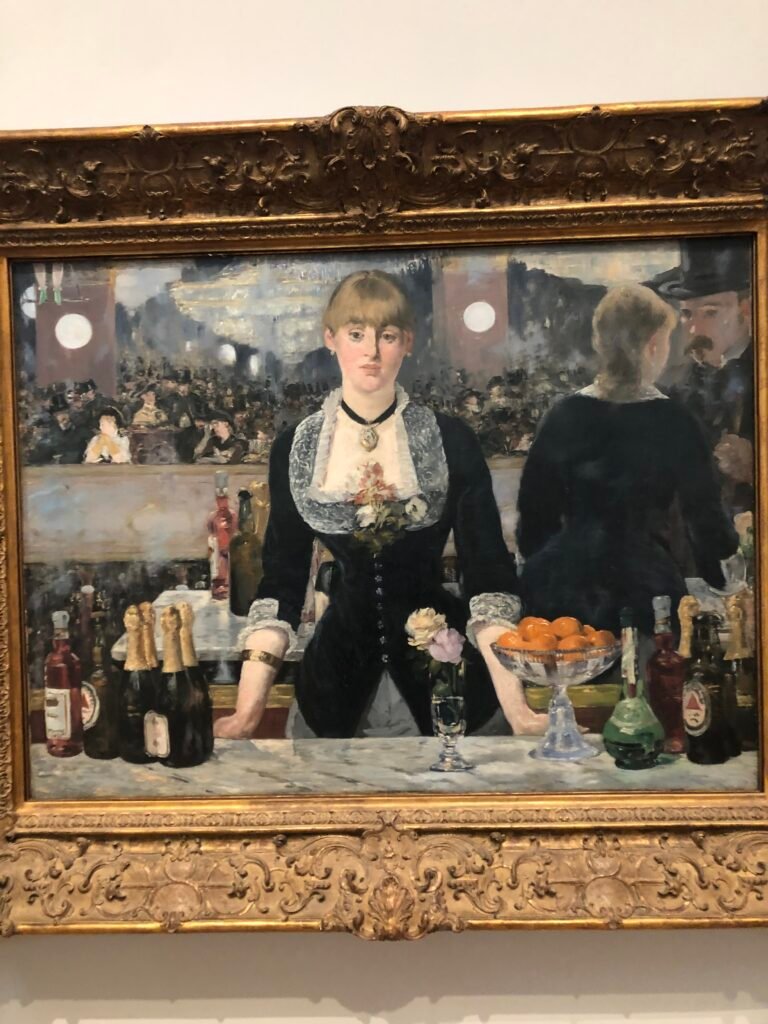
In a recent episode of the TV show Who Wants To Be A Millionaire?, the million-pound question was as follows: ‘Used since 1876, which trademarked logo is described in the James Joyce novel Ulysses and depicted in works by Manet and Picasso?’ The options were Bass Ale, The Famous Grouse, Coca-Cola and Stella Artois. The contestant, Roman Dubowski, was confident he knew the answer but he had his 50/50 lifeline and thought he may as well use it. That still left him with what he had thought in the first place – Bass Ale. He remembered having seen it in a painting he’d seen at the Courtauld. And there it is, in the bottom right-hand corner! And bingo – a million quid!